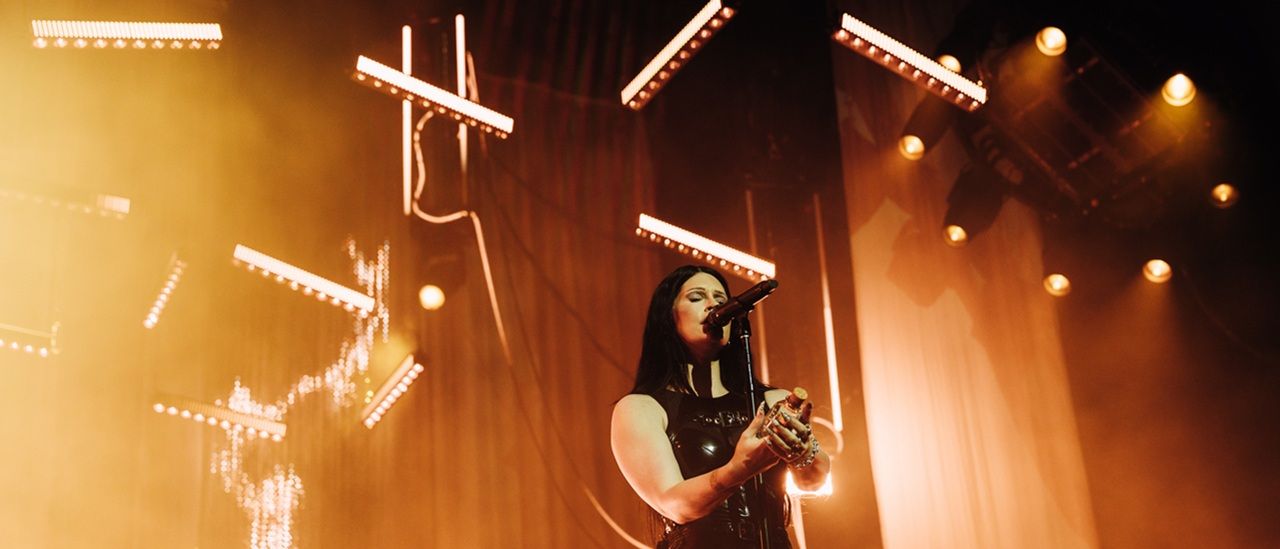
Spiritbox have done something genuinely impressive, and they're not quite ready for it yet. Both things are true.
Four years. That's all it's taken for the Canadians to go from an 800-capacity room at the O2 Academy Islington to headlining Co-Op Live in Manchester, one of the UK's biggest arenas. To put that in context: Sleep Token needed six years to get there, Ghost nine, Bring Me The Horizon a full decade. Spiritbox have speedrun the lot. The question now is whether the music, the sequencing, and the production can keep pace with the ambition.
A Torch Worth Carrying, Mostly
The billing alone tells you something about where Spiritbox's head is at. Rather than propping up the tour with legacy names to fill the room, they've backed rising acts, including Jinjer, who arrive to a full floor and immediately demonstrate why they've been talked about for years. Tatiana Shmayluk is a genuinely astonishing frontwoman, her voice lurching between off-kilter melodies and full-throated snarling with the kind of range that makes you stop mid-conversation. Pisces remains the centrepiece, its swinging dynamics drawing comparisons you wouldn't expect in a metal context. But Jinjer's technical, acrobatic prog metal doesn't always translate cleanly to a room this size. Without big, communal hooks to grab onto, the crowd watches more than it roars, and limited production means the rest of the band, all in black, half-disappear into the backdrop while Tatiana's silver get-up does the heavy lifting for everyone.
That said, the supporting slot picks up, and it's the right kind of line-up for a band making a statement about where metal's heading. This is exactly the sort of curation Spiritbox needed to get right, and they mostly have. [Evanescence managed something similar in terms of spectacle at their biggest ever London show](/uprise/music/evanescences-biggest-ever-london-show-is-a-triumphant-spectacle-powered), proving that scale and weight aren't mutually exclusive. Spiritbox aren't there yet, but they're pointing in that direction.
The Set Needs Work, and They Know It
Spiritbox themselves have admitted the sequencing isn't sorted. That honesty is refreshing. The show opens with real force, Fata Morgana and Black Rainbow hitting hard before Perfect Soul gives the room its first proper release. Keep Sweet carries that momentum, and Soft Spine lands with streamers and an almighty crowd intro. The light show and bubble machine for Tsunami Sea are small but considered touches that show the band are thinking seriously about the arena context.
The problem comes later. Holy Roller, the song Courtney LaVallee acknowledges changed everything for the band, arrives not as a finale but as a premature peak, with four more songs still to go. The energy dips. A late-set drum solo doesn't help matters. Co-Op Live isn't even at full capacity, with curtains covering the upper decks, and yet there are still early leavers heading for the door.
Crystal Roses goes somewhere genuinely unexpected, full trance energy, and new single Mourning brings Deftones-style crashing weight. But neither quite rescues the back end of the set.
The analogy that keeps surfacing is an instructive one: Metallica wrote The Black Album partly in response to realising their more complex arrangements didn't land in the rooms they were suddenly playing. Ghost found Square Hammer for the same reason. Spiritbox don't yet have that one all-conquering anthem to bring a massive room back to full roar. But here's the thing: neither did those bands, until they did.
This is a band working it out in real time, in front of real crowds. That's not a failure. That's the process. We're watching it happen, and that's worth paying attention to.