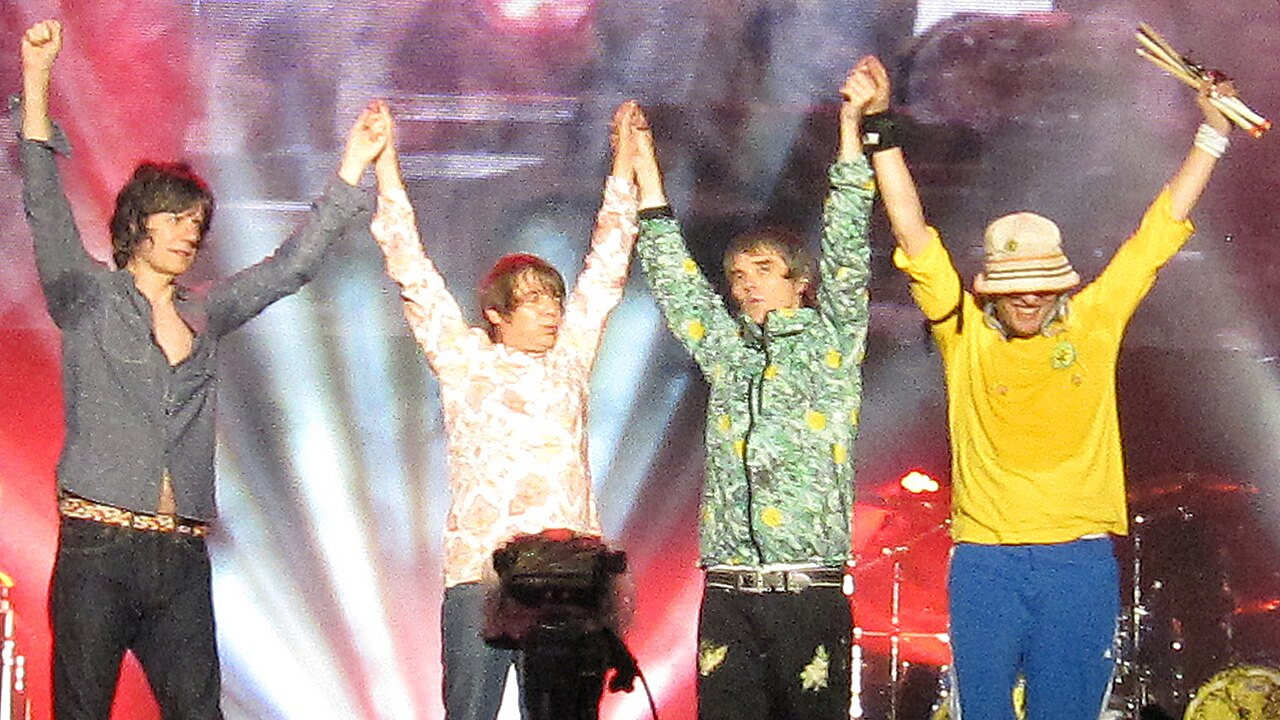
They formed in Manchester in 1983, released one of the greatest debut albums in British history in 1989, spent most of the early nineties fighting their own record label in court, released a second album that divided opinion, broke up in 1996, reunited in 2011, toured the world, hinted at a third album that never arrived, and then quietly split again. That, in blunt summary, is the Stone Roses. Except that summary tells you almost nothing about why the band still matters, why people still argue about them in pubs and on group chats, and why the story of four lads from Manchester remains one of the most compelling, infuriating, and ultimately romantic narratives in the whole of British music.
Before They Were the Stone Roses
The story starts, as so many great Manchester stories do, with school. Ian Brown and John Squire knew each other from Altrincham Grammar School for Boys, and in 1980 they formed a short-lived Clash-inspired band called the Patrol alongside singer-guitarist Andy Couzens and drummer Simon Wolstencroft. They played a handful of gigs that year, recorded a demo tape, and then the momentum stalled. What is worth clocking here is that Brown was initially the bassist, not the singer. It was only during the Patrol's final show, when he stepped up to sing the Sweet's "Block Buster!" to close the set, that something clicked. The frontman was hiding inside the bassist the whole time.
By 1981, enthusiasm had drained away to nothing. Brown sold his bass guitar to buy a scooter, which is either the most rock and roll or the least rock and roll thing you have ever heard, depending on your mood. Squire, showing the quiet dedication that would define him, kept practising guitar while working as an animator for Cosgrove Hall during the day. Brown, meanwhile, was running a Northern soul night at a club in Salford. These were not wasted years. They were the years that shaped the people who would eventually make the music.
The Long Road to an Actual Band
Squire and Couzens started another outfit, the Fireside Chaps, picking up bassist Gary "Mani" Mounfield in the process, and eventually renamed themselves the Waterfront. Their sound was pulling in influences from 1960s groups and contemporary bands like Orange Juice, which tells you something important: this was never going to be a straightforward indie guitar band. The aesthetic ear was already wide. When Squire asked Brown to join as singer, Brown was convinced partly by a chance encounter at a party at his own flat in Hulme, where Geno Washington told him directly that he would be a star and should be singing. Sometimes you need someone else to say it out loud.
In late 1983, with the Waterfront fizzling out like everything that came before it, Couzens decided to try one more time. They settled on Wolstencroft as drummer, Pete Garner as bassist despite the fact that Garner openly admitted he could barely play, and eventually pulled Squire in to cement things. Squire, crucially, was the one who came up with the name: the Stone Roses. Brown was clear later that there was no grand mythology behind it, no link to the Rolling Stones, no hidden "English Rose" meaning. "Something with a contrast, two words that went against each other," was how he explained it. That directness, that refusal of myth-making, would become very Brown indeed.
Building the Foundation
They rehearsed for six months before doing anything public, which in hindsight tells you everything about the seriousness underneath the casual Manchester cool. Wolstencroft left during that period to join Terry Hall's band the Colourfield, which stung at the time but opened the door for Alan "Reni" Wren, who joined in May 1984. The classic lineup was now in place: Brown, Squire, Mani, Reni. Four people who, for a brief window, were completely unstoppable.
Their first ever gig as the Stone Roses came on 23 October 1984, supporting Pete Townshend at an anti-heroin concert at the Moonlight Club in London. Brown had written to get the slot with a letter that read: "I'm surrounded by skagheads, I wanna smash 'em. Can you give us a show?" That letter is, frankly, a masterpiece of concise pitch writing. The gig was noticed. Journalist Garry Johnson from Sounds was in the room, arranged an interview shortly after, and tipped them for success in the magazine before the year was out. A feature followed in January 1985. The machine, slow as it was, had started turning.
The Legal Nightmare That Swallowed Their Peak Years
The debut album arrived in 1989 and the reaction was immediate and enormous. Critically acclaimed and regarded by many as one of the greatest British albums ever made, it made the Stone Roses the most important band in the country overnight. [How 80s and 90s Manchester Music Changed Male Fashion](/uprise/culture/how-80s-and-90s-manchester-music-changed-male-fashion--) happened in large part because of what this band represented: a look, an attitude, a feeling that Manchester was the centre of the universe. The Madchester movement had several standard-bearers, but the Stone Roses were the ones with the most ambitious music behind the cultural identity.
Then came the trap. The band wanted to capitalise on the success and move to a major label. Their label Silvertone refused to release them from their contract. What followed was a lengthy legal battle that chewed through the years when a band like this should have been recording, releasing, and consolidating. By the time they signed with Geffen Records in 1991, the momentum had been damaged. Not killed, but damaged. The second album, Second Coming, finally appeared in 1994, received mixed reviews, and never recaptured the euphoria of the debut. Whether that was about the music itself or about the time lost is an argument that has never been fully settled. [Primal Scream's Screamadelica](/uprise/culture/primal-scream---screamadelica-the-rock-box), released in 1991, had already helped define the post-Madchester direction, and the cultural landscape had shifted by the time the Roses returned. That is not a criticism of Second Coming so much as an observation about how unforgiving timing is in music.
The Collapse and the Long Silence
The tour supporting Second Coming became a slow unravelling. Reni departed in March 1995. Squire followed in April 1996. Brown and Mani held the remaining pieces together long enough to play the Reading Festival, then dissolved the band in October 1996. It ended not with a dramatic statement but with a kind of tired inevitability. The Roses had been fighting external battles, internal tensions, and the weight of an impossible debut for years. By the time it was over, you suspect even they were relieved.
The silence that followed was long. [There is a version of the nineties](/uprise/culture/the-craft-review-cult-high-school-horror-a-reminder-of-the) that exists in amber, preserved and gilded by nostalgia, and the Stone Roses became a fixed point in it: the band that should have been bigger, should have had more albums, should have taken over the world. That mythologising is understandable but slightly unfair. They made one transcendent album, survived years of legal chaos, and released a second record that has more going for it than the mixed reviews ever acknowledged.
The Reunion and the Third Album That Never Was
On 18 October 2011, the band announced their reunion. In 2012 they embarked on a world tour that included three homecoming shows at Heaton Park in Manchester. There was talk of a third album. In June 2012, writer Chris Coghill revealed that the band reportedly had at least three or four new tracks recorded. In June 2013, director Shane Meadows released a documentary about the reformation, titled The Stone Roses: Made of Stone. And then, in 2016, the band released their first new material in two decades, two singles, enough to confirm the creative connection still existed but not enough to satisfy what everyone actually wanted. [The Noel Gallagher generation that came directly after them](/uprise/culture/noel-gallagher---wikipedia) had built entire careers and back catalogues in the time the Roses were deliberating over album three.
By June 2017, cryptic remarks from Brown were suggesting another split. In 2019, Squire confirmed it. The third album will not be coming. The reunion had produced tours, a documentary, a handful of new tracks, and nothing more. Whether that is a disappointment or simply the honest conclusion of a band that always operated on its own terms is, again, a matter of perspective.
What the Stone Roses Actually Were
Here is the verdict: the Stone Roses were one of the most important British bands of the last fifty years, and their story is simultaneously a triumph and a cautionary tale about what the music industry can do to a band at precisely the wrong moment. One stone-cold classic album. A legal battle that swallowed their best years. A second album that came too late into a changed world. A reunion that produced memories but not the music we needed. And through all of it, four people: Brown, Squire, Mani, Reni, the classic lineup that defined the whole thing and never quite managed to put the ending on the story that the beginning deserved. The magic was real. The circumstances were brutal. That is probably the most honest way to say it.