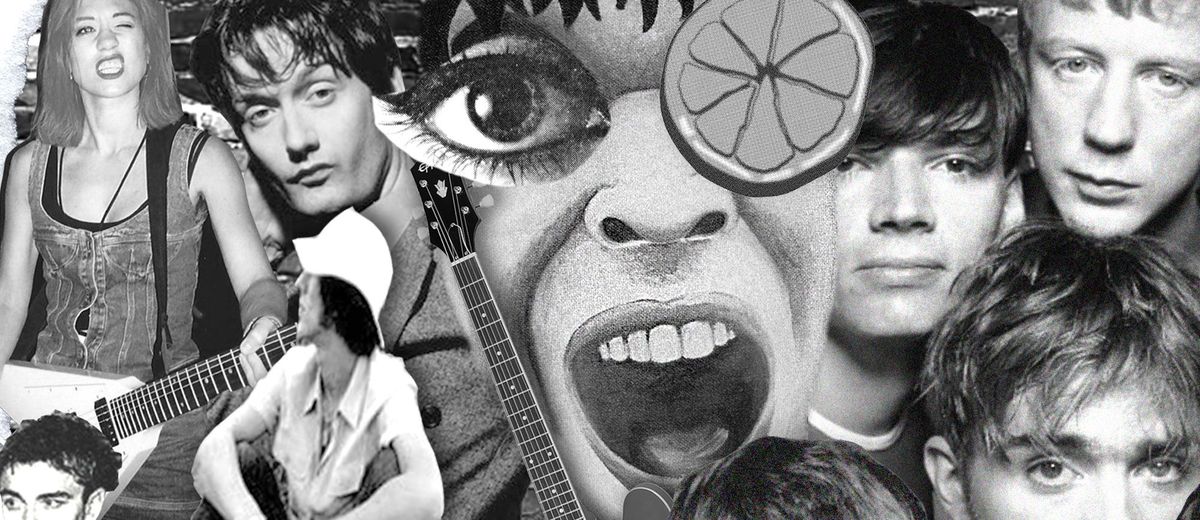
There is a version of Britpop that gets told on a loop: Liam sneering into a microphone, Damon being clever about it, the battle of 1995, Knebworth, Cool Britannia, lager and bucket hats. It is not a lie, exactly, but it is a carefully edited highlight reel, one that keeps certain names at the front and quietly shuffles others to the back. Rough Trade's recent dive into the essential Britpop canon does something useful: it refuses to let the edited version be the only version. It puts the women back in the picture. It makes space for the precursors, the outliers, the artists who existed in Britpop's orbit without ever fully belonging to its mythology. That is a more honest account of what 1993 to 1997 actually sounded like, and it is overdue.
The Gallagher Blueprint
It is almost impossible to talk about Britpop without starting with Oasis, and that is not hagiography, it is just arithmetic. Their debut album went to number one in the UK and sold 100,000 copies in its first four days. That is not just commercial success, that is a cultural rupture. Something in Liam and Noel Gallagher's combination of swagger and sincerity hit the country squarely in the chest at a moment when it needed hitting.
The second album landed even harder. On its first day on sale, What's the Story, Morning Glory was moving through HMV's London stores at a rate of two copies per minute. Two copies per minute. Think about what that means logistically, let alone culturally. Behind those numbers sat sessions reportedly defined by the brothers' increasingly combustible relationship, a tension that would eventually cause the band to implode in 2009. The chaos and the genius were always the same thing with Oasis, which is part of what made them so compelling and so exhausting in equal measure. [The story of Noel Gallagher](/uprise/culture/noel-gallagher---wikipedia) is one of the great contradictions in British music: a man who built an empire on relatability and then spent decades being anything but.
Blur and the Art School Question
Blur's story is inseparable from the Oasis story, and that is partly their own fault and partly the media's. The so-called battle of Britpop in 1995, where the two bands scrapped for chart positions, produced one of the most enduring and arguably most contrived narratives in British music history: the southern art school wankers versus the working-class heroes from Manchester. Damon Albarn and company met in Goldsmiths University circles and made no secret of their influences, their references, their education.
What that framing missed is that Blur were genuinely brilliant. Parklife, which landed in 1994, is described in the Rough Trade piece as "as English as a rainy Sunday in front of the gas fire," and that is exactly right. It is a record that smells like a specific time and place. It is also far stranger and more ambitious than the lad-rock tag the band acquired during the chart battle. Their debut Leisure in 1991 is credited as one of the early seeds of the Britpop sound, heavily influenced by The Charlatans and The Stone Roses, pop-fuzz and catchy hooks before anyone had given the genre a name.
The Women the Story Keeps Burying
Here is where the Rough Trade piece earns its worth. The Britpop scene was widely understood at the time to be a boys' club, and that understanding was accurate but not complete. Elastica, fronted by Justine Frischmann alongside a band built around women who could genuinely play, broke the record for the fastest-selling debut album in the UK in 1995. Let that land. Elastica outsold everyone. Their sound had more edge than the glam lyricism of Suede, sharper and more abrasive, driven by Frischmann and Donna Matthews on guitar and Annie Holland on bass.
Frischmann later left music and spent years helping develop M.I.A., co-writing and producing demos for M.I.A.'s first album, Arular. That lineage matters. The same instincts that gave Elastica their angular, punk-adjacent bite fed directly into one of the most distinctive British pop artists of the following decade. Then there is Lush, simultaneously labelled shoegaze and Britpop, built around Miki Berenyi and Emma Anderson, two female guitarists and vocalists in a scene that barely acknowledged women existed. Their most famous song, Ladykillers, has been read as a feminist anthem. Berenyi has since written a memoir, Fingers Crossed, which Rough Trade named their Book of the Year for 2022, an eyewitness account of what it actually felt like to be a woman navigating that industry at that time. It should be required reading alongside any Britpop playlist.
And then there is Sleeper, fronted by Louise Wener, an excellent and charismatic songwriter whose talent was consistently misrepresented and undermined by a music industry that was institutionally hostile to women in guitar bands. Sleeper were responsible for some of the era's biggest moments and yet they remain, still, frustratingly underlisted in the canonical accounts. That is not an accident. It is a consequence of who was writing the history and whose tastes were treated as the default.
The Ancestors and the Outliers
No honest Britpop account starts in 1993. [The Stone Roses](/uprise/culture/the-stone-roses---wikipedia) belong to the Madchester scene, psychedelic and dance-influenced, but their guitar-driven sound and their challenge to the status quo laid essential groundwork for what followed. They handed something to a generation of bands who then built a different kind of music on top of it.
The La's are another essential predecessor. One studio album in 1990, a jangly, well-crafted record that gave the world There She Goes, a song that would have sat comfortably on any Britpop compilation without anyone blinking. Noel Gallagher once said that Oasis wanted to finish what The La's started. That quote tells you everything about where the Britpop bands were drawing their water from. Supergrass brought youth and exuberance into the mix; I Should Coco topped the charts and earned a Mercury nomination, capturing adolescence with the same unembarrassed energy as anything Oasis or Blur produced. Suede, part of the scene's defining quartet alongside Oasis, Blur and Pulp, arrived first, refashioning 1970s Bowie's glam aesthetic into something that worked as a catalyst for everything that followed, even as they later pushed back against the Britpop label.
What the Revisionism Gets Right
Rough Trade's list also acknowledges post-Britpop, the artists who absorbed the era's influences but had something different to say. The Verve's Urban Hymns is the obvious example: rousing rock dynamics built around Richard Ashcroft's tender and at times outsized songwriting, a record that leaned into shoegaze textures even as it landed the anthems. It sits at the Britpop table without quite belonging there, which is exactly the right place for it.
This is the more complicated and more interesting version of the story. Britpop was not a sealed box. It had porous edges, contested membership, and a cast of characters who were shaped by it without ever fitting neatly inside it. The M.I.A. connection alone, running from Elastica's punk energy through Frischmann's producing work to one of the most confrontational pop records of the 2000s, shows how far the ripples actually travelled.
The Verdict
We have been telling the Britpop story the lazy way for thirty years. We do Oasis and Blur and occasionally Pulp, we nod at Suede, and then we move on. What gets lost in that version is precisely the people who made the scene more interesting and more contested than the heritage-rock mythology allows. Justine Frischmann, Miki Berenyi, Louise Wener. These are not footnotes. They are part of the story, and the misogynistic industry of the time did a thorough job of making sure they were treated as if they were not. [The era has been sold back to us](/uprise/culture/the-craft-review-cult-high-school-horror-a-reminder-of-the) as a golden age of Britishness, and in some respects it was. But golden ages have a habit of only looking golden for certain people. The full Britpop story, the one worth telling, includes the women who built it alongside the men who got the credit for it.