Liam Gallagher raiding the Madchester era for Pretty Green inspiration is not a surprise. It is, however, exactly right.
The new Pretty Green SS17 collection, titled "90s Rave: Part of the Weekend Never Dies," pulls directly from the acid house and Madchester scenes that defined a particular kind of Manchester identity in the late 1980s and early 1990s. For a label built around Gallagher's personality and his city's culture, it is arguably the most honest thing Pretty Green has ever done.
What The Range Actually Looks Like
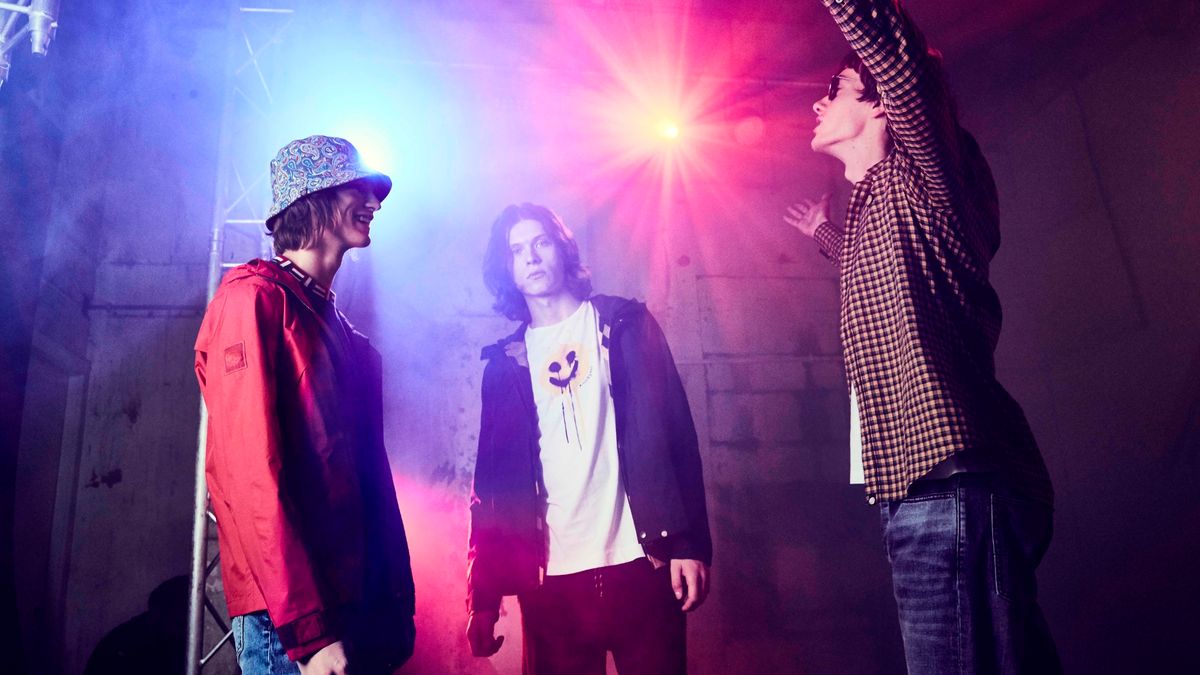
The collection does not just gesture vaguely at the era. It goes in properly. T-shirts carry a melting version of the smiley face, the symbol that became shorthand for the acid house movement in the late 80s. There are decorated collar tops and bucket hats of the kind the Stone Roses made their own. The black and yellow chevrons that anyone who set foot in the Hacienda would recognise are referenced throughout.
The fashion shoot places models in what is styled as a warehouse rave, which gives the whole thing a sense of occasion beyond just flogging clothes. It is mood-setting. Gallagher has always understood that Pretty Green is selling something bigger than fabric, and this collection leans into that more than most.
The Names Behind The Inspiration
What makes the collection's written blurb worth quoting is how specific it gets. This is not vague nostalgia. The copy references the Hacienda, the Stuffed Olive, and specific club nights: Hot on Wednesdays, Nude on Fridays. It names Mike Pickering, Tony Wilson, the Donnelly brothers and Bobby Langley as early adopters of the scene. It credits the Happy Mondays, Voodoo Ray and Graeme Park as key figures in turning acid house into something that felt distinctly Mancunian.
That level of detail matters. It is the difference between a fashion label cashing in on a general aesthetic and one that has actually done its homework, or at least has people around it who lived through it. Whether Gallagher was personally in the Hacienda's Nude nights as a teenager or is working from cultural memory and conversation with the right people, the range clearly respects its source material.
The blurb frames the era with some ambition too, calling it "a true Velvet Revolution." That might be a stretch, but the broader point is fair enough. The acid house and Madchester movement genuinely did shift British popular culture in ways that were not just about music. It was social, generational and geographic. A fashion collection reaching back to it in 2017 is not ridiculous. It would only be embarrassing if it got it wrong.
Pretty Green's Wider History
Gallagher launched Pretty Green in 2009. Previous collections have drawn on Mod fashions of the 1960s and on his musical influences including The Who, The Beatles and Pink Floyd. The Burnage-born star opened his flagship Manchester store on King Street in 2010, and the label has since expanded across the UK and into Japan.
This collection is something of a homecoming within that trajectory. Mod and classic rock are not Gallagher's origin story in the same way that acid house and Madchester are. He grew up in Manchester during that era. The music he made in Oasis grew in the soil that those scenes turned over. Going back to it for a fashion range is not reinvention, it is acknowledgement.
The parkas are still there, naturally. No Pretty Green collection drops without them. Some things do not change, and in Gallagher's case that is a feature rather than a limitation.
For anyone interested in how British culture of that period bleeds into everything that came after it, our piece on [The Charlatans and their place in 90s music history](/uprise/culture/the-charlatans-totp-rewind-the-90s) is worth your time. And if you want a broader reminder of just how much the 90s produced, [our look at TFI Friday's music guest list](/uprise/culture/10-amazing-music-guests-who-prove-tfi-friday-ruled-1990s) makes the case pretty effectively.
The Promo And The Wider Context
The video promotion for the collection features music from an unknown band called God on My Right, which is an interesting choice. It keeps the focus on the clothes and the visual world being constructed rather than leaning on recognisable nostalgia tracks to do the emotional heavy lifting.
At the time of the collection's release, Gallagher was also in the middle of building his solo career, with a debut album anticipated but not yet confirmed. Oasis reunion speculation had been running hot following the release of the band's documentary Supersonic. Gallagher had been publicly open to a reunion, putting himself at one hundred per cent. Noel had not returned the same energy.
None of that changes what the collection is or what it represents, but it is worth noting the moment it arrived in. Gallagher was in the process of working out who he was without Oasis, and part of that answer was a fashion range that pointed directly back to the Manchester scene that produced him.
Our Verdict
This is Pretty Green at its most coherent. The collection has a clear point of view, a genuine connection to the city and the culture it is drawing from, and enough specific detail in both the clothes and the surrounding materials to feel like something more than a mood board raided for profit. Gallagher could have kept recycling the Mod aesthetic indefinitely. Going back to acid house and the Hacienda instead shows better instincts. It is the right inspiration, handled with more care than you might expect.