
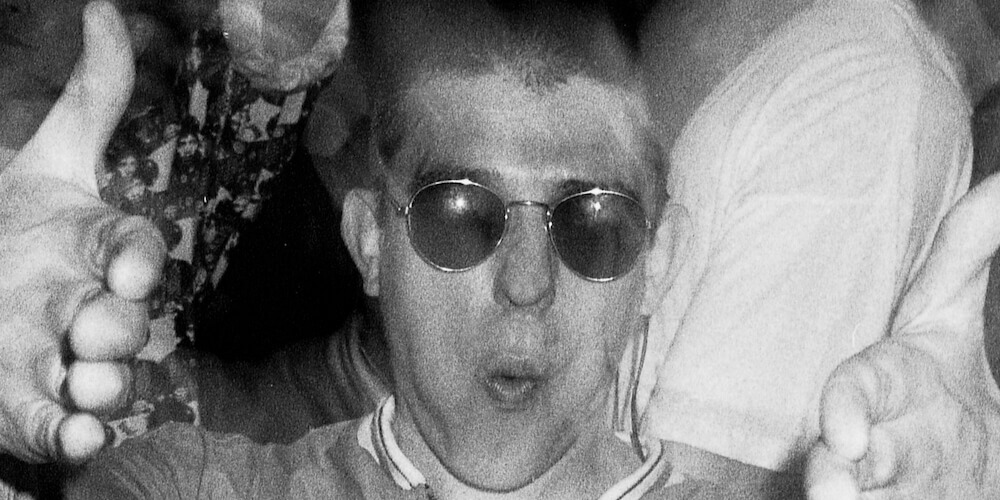
There is a version of The Haçienda story that gets told so often it has worn itself smooth: the smiley face, the fog machine, the Summer of Love, the queue round the block on Whitworth Street. What that version leaves out is everything that came before it, and everyone who was there to see the before. Peter J Walsh was one of those people. He first walked through the doors in 1985, three years before acid house turned the place into a national obsession, and he had a camera with him. What he built over the years that followed is not a nostalgia archive. It is a documentary record of a city working something out in real time, before anyone had thought to give it a name.
The Club Before the Myth
The Haçienda opened in May 1982 on Whitworth Street, a Factory Records and New Order venture that spent its early years finding its footing. The story of how it got from post-punk hangout to acid house cathedral is a lot messier and more interesting than the highlight reel suggests. Its first resident DJ, Hewan Clarke, had already been playing at the Reno in Moss Side, which means the club's roots reach directly into a tradition of Black Manchester club culture that existed long before Factory Records had any say in anything. That is not a footnote. That is the foundation.
Greg Wilson brought electro and mixing to a weekly night there in 1983. From 1986, Nude, run by Mike Pickering and Martin Prendergast, was already moving house records through the system before acid house had even become a phrase people used. The Haçienda, properly understood, sits inside a much longer Manchester history of soul, jazz-funk, queer nightlife, electro, independent record shops and imported music. It did not start any of that. It became the place where several of those strands found each other.
This is the club Walsh walked into in 1985, before the crowded dancefloors and before the national press arrived to write it all up. That timing matters enormously when you are trying to understand what his photographs actually show.
A Photographer Who Knew the Room
Walsh was not a journalist who showed up with a commission and a press pass. He was a clubber first, a documentary photographer who had come up through a Manchester photography co-operative where members processed their own film, made contact sheets and produced black-and-white prints, then met monthly to compare and criticise each other's work. He had photographed demonstrations in Manchester and worked on social documentary projects across the North West before acid house became his subject. That background shaped everything about how he moved inside a venue.
"The training I received in all aspects of documentary photography during this time would prove invaluable to me as the rave scene hit Manchester just a few years later," he said. That is not a throwaway line. The discipline of working on film, in low light, with a finite number of frames, with no ability to review what you have just taken: that demands a specific kind of judgement that you either have or you do not. Walsh had it, and he had developed it long before anyone was dancing to house music at The Haçienda.
Because he was a regular, he was familiar to the people he photographed. That changes everything about how documentary photography works in a space like this. The difference between a stranger with a camera and someone who knows the security on the door, recognises the regulars, understands the room: it shows up in the images. People do not perform for Walsh's lens in the way they might for someone who had no business being there.
What the Photographs Actually Show
The scope of Walsh's archive is worth spelling out clearly, because it is wider than most people expect when they hear "club photography." Yes, there are dancefloor shots. But there are also photographs of queues, of club staff, of security, of DJs and bands, of the spaces around and outside the events. Ben Kelly's distinctive interior, the striped columns, the warning markings, the bollards and hard surfaces, runs through the whole body of work. These are not fetishised as design objects. They are occupied: leaned against, passed in queues, used as part of the actual physical experience of being in that building.
By 1988, nights like Hot were bringing a marked change in the music and the crowd, and Walsh was photographing it while also working for City Life and the NME. His pictures recorded acid house moving from individual records and specific club nights into something that was visibly reshaping youth culture: the clothing changed, the audience grew, the dancefloor started attracting serious national attention. Walsh photographed all of it without deciding in advance which parts were important.
That range is exactly what gives the archive its value. When bands, labels, designers, promoters and magazines are all contributing to the same gathering moment, a photographer who only points the camera at the stage misses the actual story. Walsh pointed it at everything. [The dancefloor itself was the medium](/uprise/culture/exploring-music-and-dance-in-madchester-culture), and he understood that instinctively.
Beyond the Building
One of the most significant things Walsh did was refuse to treat The Haçienda as if it existed in isolation. His archive includes photographs from the Manchester demonstration against Clause 28 on 20 February 1988, and from Joy Rave at Ashworth Valley near Rochdale in 1989. That is the same photographer moving between political street action and an outdoor rave in the same period, documenting the same community in different contexts.
Joy Rave is a particularly important piece of the picture. By 1989, house and rave culture had already pushed well beyond licensed city-centre venues. Parties were happening in warehouses, in temporary locations, in fields and valleys across the North West. The Haçienda was central to the story, but it was one node in a network that included Blackburn warehouse parties, Liverpool clubs, regional promoters and gatherings that existed entirely outside the conventional venue system. Walsh's photographs show that network rather than just its most famous address.
[This is the Madchester story that often gets flattened out in retrospect](/uprise/culture/madchester---wikipedia): the idea that it all happened in one building, to one crowd, under one roof. The reality was always more dispersed, more regional, and harder to contain than that version suggests.
The Night the Club Almost Stopped
In early 1991, The Haçienda announced an immediate temporary closure. Walsh had been told by Paul Cons that the club was shutting, and he moved quickly. He obtained permission to work in the basement, a space reached through the Gay Traitor bar, which he found full of lighting equipment, props and drinks barrels. He hung a cloth background, set up a temporary portrait studio, and enlisted a Haçienda regular named Leslie to bring people down from the dancefloor.
Walsh wanted high contrast black-and-white results and processed the film in paper developer specifically to push the grain up. The cold, the lack of heating in the basement in January, explains why several of the people he photographed kept their coats and jackets on. Each person stepped away from the music and stood in front of his camera during a weekend when nobody knew whether the venue would ever reopen. It did reopen, and it kept going until 1997. But the photographs were made in that specific atmosphere of uncertainty, and they carry it.
Those 51 portraits were published by British Culture Archive in 2025 as "Original Ravers," more than three decades after the negatives were processed. Previously unseen, newly scanned from Walsh's archive. The delay does not diminish them. If anything it sharpens them: faces from a Friday and Saturday night when the future of one of the most important clubs in British music history was genuinely unclear.
Why the Chronology Changes Everything
The key thing about Walsh's archive, and the reason it deserves more attention than it usually gets, is the before. [Madchester as a named, packaged, mediated thing](/uprise/culture/a-brief-history-of-madchester-culture) arrived after the fact, as these labels always do. By the time the press had a word for it and the bands had the magazine covers to prove it, the thing itself was already past its purest point. Walsh was photographing Manchester while the connections were still forming, not after they had been frozen into an official account of what happened.
That is the difference between documentation and reconstruction. Reconstruction is what happens when someone arrives after the story has been told and tries to illustrate it. Documentation is what happens when someone is already in the room, already familiar, already paying attention. Walsh's photographs are documentation in the proper sense: made during the period, not after it, by someone who was part of the scene he was recording rather than observing it from outside. [The voices that were there first always get there last](/uprise/culture/old-ravers-are-wanted-to-tell-the-story-of-the), which is precisely why archives like this one matter so much.
The Haçienda has been written about, mythologised, turned into a documentary, turned into a building that no longer exists. What Walsh's photographs provide is something different: not the myth, but the material. The queue, the door, the bollard, the face under the flash, the basement in January with the cloth backdrop and the cold. That is what it was actually like. And that is worth considerably more than the version that has been smoothed and sequenced and sold back to us.