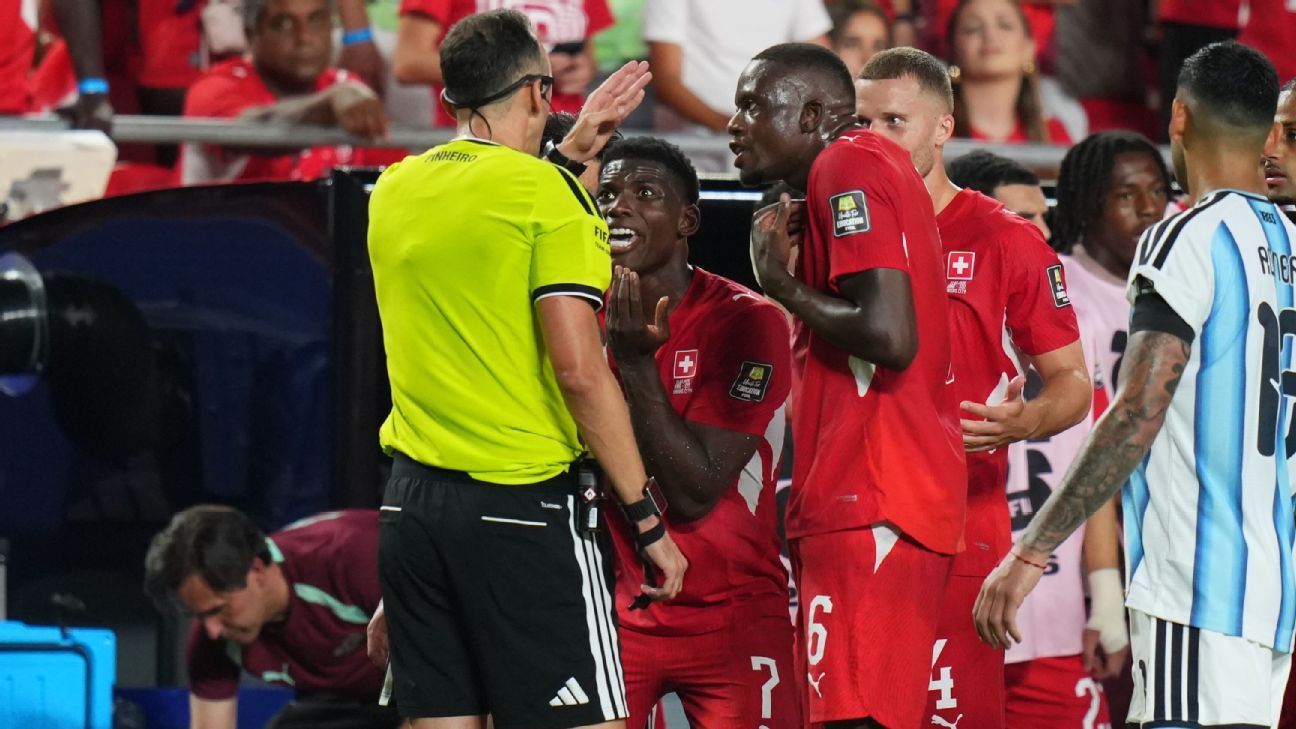
Football's governing bodies just admitted one of their own officials got it wrong at a World Cup quarterfinal — and somehow we're supposed to trust the system.
IFAB, the body that writes and interprets the laws of football, has clarified its guidance to referees and confirmed that the VAR process which led to Breel Embolo's red card during Switzerland's World Cup quarterfinal against Argentina was handled incorrectly. Not a debatable call. Not a matter of interpretation. Wrong process.
What Actually Happened
Embolo was sent off during a high-stakes World Cup knockout match. The red card effectively changed the shape of the game at a point where Switzerland were already fighting one of the tournament's heaviest hitters. Now IFAB has looked at the incident and said, plainly, that the VAR intervention which led to that dismissal did not follow the correct procedure.
This isn't IFAB offering a quiet, coded steer to referees in private. This is a public clarification — which tells you something about how badly they felt the process went. When governing bodies put something in writing for the world to read, they've decided the alternative (staying silent) is worse. That's the level we're operating at.
The broader problem here isn't one referee's judgment call. Judgment calls happen. What IFAB has confirmed is a procedural failure — meaning the framework that's supposed to catch errors and apply them consistently didn't work as it should. VAR was sold to football fans as the correction mechanism. It was supposed to stop the obvious howlers. In this case, it appears to have caused one.
VAR's Credibility Problem Isn't Going Away
We've been through this cycle enough times now to know how it goes. High-profile incident. Controversy. Governing body statement. Brief period of reflection. Back to business. Nothing fundamentally changes.
The issue with VAR was never purely technical — it was always about the humans applying it. The technology can show you an incident from thirty angles in slow motion, but it still requires someone to decide what they're looking at and whether the correct process is being followed. When that breaks down at a World Cup quarterfinal, with one of the most high-profile pools of officiating talent in the sport, it's hard to argue this is just a one-off.
[England's own experience of shifting football governance decisions](/getohedz/football/england-lose-euro-2028-automatic-spot-after-uefa-rule-change) shows that these bodies are perfectly capable of making consequential calls that affect teams without adequate accountability. The Embolo case is a different context but the same underlying frustration: decisions are made, tournaments are shaped, and the clarification arrives long after the damage is done.
For Switzerland, there's no remedy here. The World Cup is over. Embolo got sent off, the match played out, and Argentina progressed. IFAB's acknowledgement changes precisely nothing for the Swiss. [Mbappé's own reflection on what his team owed the French public](/getohedz/football/mbapp-to-france-we-owed-you-a-better-ending) at least came from within — here, an external body is admitting fault, and the team affected gets nothing but a footnote.
Our Take
IFAB confirming the VAR process was wrong is the right thing to do — transparency matters, and they deserve credit for saying it publicly. But it doesn't fix what happened, and it doesn't fix a system that keeps producing these moments. Until the process is genuinely tightened and referees are better supported in applying it correctly under pressure, we'll be writing this same article again. Different tournament, different player, same story.